Dear Parishioner,
The first reading from Isaiah in this final Advent Sunday takes us back to some time in the late eighth century BC and the question as to whether the small kingdom of Judah will survive under its King, Ahaz. The King of Israel and the King of Syria have already invaded Judah but have failed to take Jerusalem or capture King Ahaz, who decides to go and seek help from Assyria, a superpower at the time, and one with a highly aggressive foreign policy. As the King’s adviser, Isaiah argues strongly against this. The dynasty of David, he says, will not survive through power politics, but only as a result of trust in God. The sign given by Isaiah is that ‘the maiden is with child and will soon give birth to a son whom she will name Emmanuel, a name which means “God-is with-us”’. Ahaz doesn’t listen. Instead Assyria smashes the coalition that threatens Ahaz, but he leaves Judah untouched, provided it shows its submission with regular tribute. It won’t be until 587 BC when Judah is overrun by the Babylonians, its capital Jerusalem destroyed, and the people taken off into exile.
When Matthew writes his gospel he adopts that sign given to Ahaz and gives it a whole new meaning. The child is not only the son of David, but the Son of God, an understanding by the early Church that only came about after the resurrection. Matthew himself writes some forty years after the resurrection and is anxious to show that Jesus was the Son of God at his conception. That is why the virginity of Mary is so important: it points to who Jesus really is. As for the quiet man Joseph, when he exercises his right to name the child he becomes the legal father. Thus it is through Joseph that Jesus becomes “son of David.” What a complex web.
A virgin mother has no precedent in the religious tradition and such a truth will always shock. Often we only give permission to truth to get through to us when it meets with our approval. As one writer has noted: “We like our truths familiar and tame; we do not like them to jolt us out of the familiar into the realm of new possibility,” And nor is the Holy Spirit who came to Mary tame. Rather it is a force which kickstarted creation when the very breath (spirit) of YHWH breathed life into creation (Gen.1:2). And it is through that same power that the virgin Mary conceives and gives birth to the Son of God. In her a new creation comes to life.
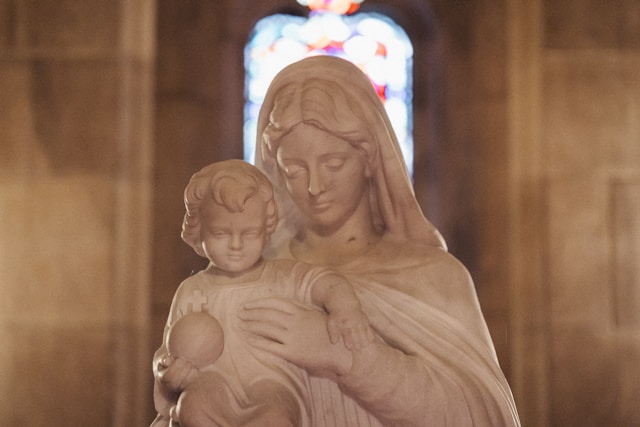
The power politics of the Middle East has hardly changed over the past two and a half millennia or more, a frightening reality which continues to affect all our lives, directly or indirectly. But perhaps we need to reflect, too, on another context: Mary is the woman who bring Jesus’ real presence into the world and she can truly say of him ‘this is my body, this is my blood’. Through her his presence is known and celebrated. For he is not only the son of David and the Son of God: he is her son whom she will bring forth for the life of the world.
Deacon Alex